

Indonesia’s ambition to transition toward a robust Digital Public Infrastructure (DPI)—anchored by the implementation of the Digital ID system (Identitas Kependudukan Digital/IKD)—marks a definitive paradigm shift in the nation’s digital transformation journey.
However, the trajectory toward universal IKD adoption remains highly uneven. Drawing on data from the Indonesia Digital Society Index, our preliminary examination of regional digital readiness reveals a stark disparity between regions. These disparities manifest across all the critical architectural elements of the Digital Public Infrastructure (DPI) ecosystem development: infrastructure, government digitization, literacy, and service creation.
For Indonesia to reap the benefits of effective and equitable IKD, KETEMU proposes a shift in DPI governance frameworks from uniform mandates to a nested framework—one that combines national strategic alignment with targeted, province-specific intervention strategies.
The Geography of Digital Exclusion
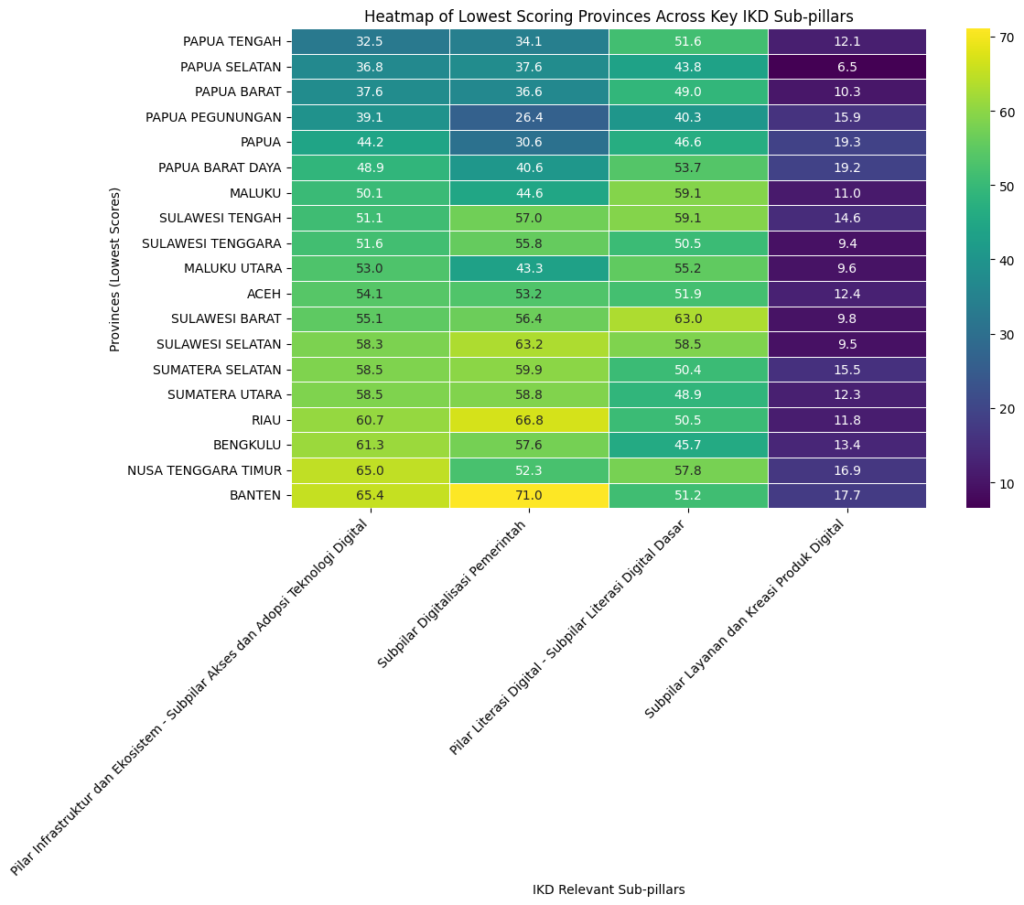
Visualizing the landscape through a readiness heatmap clarifies the extent of the challenge. The analysis highlights a glaring geographic divide, with provinces in the Papua region, specifically Papua Tengah, Papua Selatan, Papua Pegunungan, Papua Barat, and Papua, consistently appearing as the least performers across all four sub-pillars.
These provinces are represented by the darkest shades in our analysis, indicating a pronounced, broad-based struggle with digital infrastructure and government digitalization that requires urgent attention.
The Papua region and Eastern provinces such as Maluku and Sulawesi Tenggara display systemic deficits that act as a fundamental barrier to digital identity adoption. For these provinces, merely rolling out an IKD system without addressing underlying issues in access to technology, digital literacy, and government service digitalization would likely face significant barriers to adoption.
Other regions like Aceh, Bengkulu, and Sumatera Utara show more heterogeneous patterns, suggesting that they face specific bottlenecks rather than an across-the-board lack of readiness.
Source: Indonesia Digital Society Index
IKD Readiness
The readiness table below further unfolds critical performance gaps that policymakers must address to ensure the IKD is both available and functional. The data points to a particularly severe bottleneck in the “Subpilar Layanan dan Kreasi Produk Digital” (Digital Service Creation).
The Papua region provinces (Papua Pegunungan, Papua Tengah, Papua Selatan, Papua, Papua Barat Daya, Papua Barat) consistently appear in this list, particularly with very low scores in ‘Subpilar Digitalisasi Pemerintah’ (Government Digitalization) and ‘Subpilar Layanan dan Kreasi Produk Digital’ (Digital Service and Product Creation). This augments the severe challenges they face across multiple digital readiness dimensions.
Even in provinces with moderate infrastructure, such as Sulawesi Tenggara (51.57) or Maluku Utara (53.00), the ability to create and sustain digital services is critically low (9.45 and 9.61, respectively). This suggests that infrastructure rollout is only the first step. Without fostering an environment where digital services can actually be built and utilized, the IKD system will remain an abstract utility rather than a daily tool for citizens.
| Pillars | Infrastructure and Ecosystem Pillar – Digital Technology Access and Adoption Sub-pillar | Government Digitalization Sub-pillar | Digital Literacy Pillar – Basic Digital Literacy Sub-pillar | Digital Service and Product Creation Sub-pillar |
| Provinces | ||||
| Aceh | 54.07 | 53.20 | 51.88 | 12.42 |
| Banten | 65.39 | 71.04 | 51.22 | 17.73 |
| Bengkulu | 61.31 | 57.57 | 45.66 | 13.41 |
| Maluku | 50.15 | 44.60 | 59.07 | 11.01 |
| Maluku Utara | 53.00 | 43.33 | 55.22 | 9.61 |
| Nusa Tenggara Timur | 64.98 | 52.29 | 57.82 | 16.86 |
| Papua | 44.18 | 30.63 | 46.64 | 19.27 |
| Papua Barat | 37.58 | 36.63 | 48.95 | 10.35 |
| Papua Barat Daya | 48.85 | 40.64 | 53.72 | 19.22 |
| Papua Pegunungan | 39.06 | 26.36 | 40.32 | 15.95 |
| Papua Selatan | 36.78 | 37.58 | 43.77 | 6.55 |
| Papua Tengah | 32.53 | 34.09 | 51.59 | 12.05 |
| Riau | 60.73 | 66.82 | 50.45 | 11.79 |
| Sulawesi Barat | 55.11 | 56.43 | 63.02 | 9.78 |
| Sulawesi Selatan | 58.28 | 63.23 | 58.49 | 9.53 |
| Sulawesi Tengah | 51.11 | 57.02 | 59.10 | 14.57 |
| Sulawesi Tenggara | 51.57 | 55.81 | 50.48 | 9.45 |
| Sumatera Selatan | 58.53 | 59.93 | 50.43 | 15.50 |
| Sumatera Utara | 58.54 | 58.84 | 48.87 | 12.33 |
Source: Indonesia Digital Society Index
Strategic Governance Interventions
To address these significant disparities and foster an enabling environment for IKD adoption, governance models must shift from uniform mandates to targeted, province-specific strategies.
KETEMU proposes the following recommendations to prioritize foundational development over a deterministic technical rollout:
-
- Investment must move beyond simple network expansion. For provinces with infrastructure deficits, governance frameworks should prioritize subsidized access to devices and the establishment of community digital hubs. These centers, equipped with internet access and trained facilitators, are essential to bridge the digital divide and support citizens in utilizing the IKD system.
-
- Literacy programs must be culturally and linguistically contextualized. Tailoring curricula to local needs, covering basic digital skills, online safety, and the practical, tangible benefits of IKD, is crucial for ensuring adoption in underserved regions. Additionally, there is a need to design specific programs for vulnerable groups (women, the elderly, people with disabilities) and establish robust feedback mechanisms to continuously adapt strategies based on real-time citizen experiences.
-
- Local integration as the catalyst for IKD success. Given that some provinces report government digitalization scores as low as 26.36, the success of IKD relies on local government agencies capable of integrating the system into daily services. This requires extensive training for civil servants and the development of user-friendly digital interfaces optimized for varied regional conditions.
-
- Empowering local hubs to close the digital service gap. To bridge the gap in digital service creation, governments must support local innovation hubs. By offering financial incentives for businesses to adopt digital platforms and integrate IKD, the state can foster a self-sustaining ecosystem that makes digital identity a valuable, everyday asset rather than an abstract requirement.
The success of the IKD program is inextricably linked to our ability to address regional digital disparities. Governance of this transition requires a granular understanding of local challenges, moving away from a one-size-fits-all approach toward a targeted, multi-tiered strategy. By addressing the specific infrastructural and capacity deficits highlighted in the analysis, Indonesia can ensure that the benefits of its IKD are shared by every citizen, regardless of their geolocations.