

Imagine a citizen living in a rural sub-district of East Java. To apply for a small business loan, update her family’s health insurance, or register her child for school, she must navigate a familiar bureaucratic ritual: gathering physical copies of her ID card (Kartu Tanda Penduduk) and family card (Kartu Keluarga), traveling to the local sub-district office (kecamatan), and waiting in long lines under the midday heat.
When Indonesia launched the Identitas Kependudukan Digital (IKD) app, it promised to eliminate these physical barriers. As a cornerstone of the nation’s emerging Digital Public Infrastructure (DPI), IKD was designed to compress a citizen’s entire civic identity into a secure, pocket-sized digital wallet. The vision was for increased convenience, slashed administrative overhead, and a direct bridge across the archipelagic divide.
But the true currency of DPI is trust. When a government digitizes identity, it asks citizens to trade familiar physical documents for pixels and servers. If that transition is marred by technical friction, trust evaporates, and the platform fails to scale.
To understand how this dynamic unfolds in practice, KETEMU analyzed 10,000 citizen reviews of the IKD app from mid-2025 to mid-2026. What emerged is a narrative of initial frustration, deep civic skepticism, and a technical turnaround that offers inspiration for digital governance across the Global South. We conclude this article by leveraging these findings to outline strategic lessons for policymakers and stakeholders worldwide.
When Code Meets Reality
In its early iterations, the IKD app faced a steep uphill battle, delivering a highly polarized user experience. In versions 2.0.1 and 2.0.4, the application suffered from a severe trust deficit, with 1-star reviews dominating user feedback. For every citizen who successfully set up their digital identity, two or three others were left locked outside the digital gates.
To understand why early adoption felt so punitive, we broke down the specific complaints embedded in those thousands of 1-star reviews.
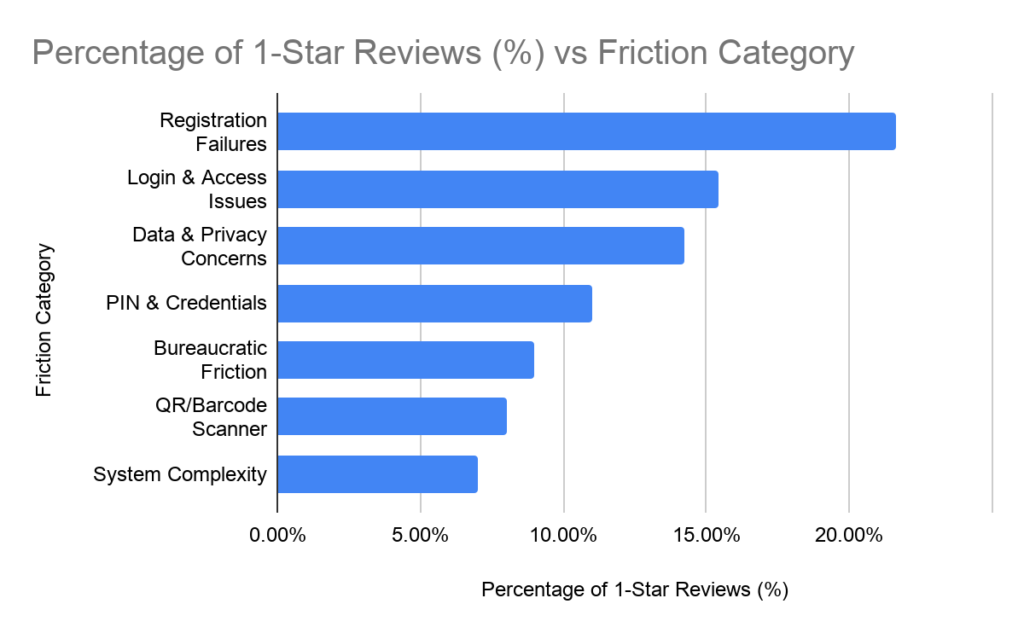
Note: Data compiled from 1-star reviews for older IKD versions 2.0.1 & 2.0.4.
Registration failures were the single largest hurdle, preventing 21.6% of users from even beginning their digital journey. Login and access issues followed closely at 15.4%, leaving successfully registered citizens inexplicably locked out.
However, the most telling insights lie in the qualitative feedback. A recurring grievance was the irony of a ‘digital’ system that still required physical, human-in-the-loop interventions. Over 9% of frustrated users explicitly cited Bureaucratic Friction, calling out the need to interact with local officers (petugas), sub-district offices (kecamatan), or civil registry offices (disdukcapil).
“Why are government apps all like this? None of them work well. It’s already hard to log in, and then we are told we have to register with an officer anyway. It’s inconvenient and doesn’t help at all.”
“This is supposed to be digitalization, so why do we still have to go through the hassle of visiting the Disdukcapil office?”
When a digital identity app requires a citizen to take a day off work just to visit a government office to scan a QR code, the value proposition of DPI collapses. Instead of bypassing the bureaucracy, the app simply becomes another layer of it.
From Technical Bugs to Civic Suspicion
The critical takeaway from Indonesia’s early experience is that technical friction is never just a technical problem. In the minds of citizens, a broken interface reflects a broken contract between the state and the public.
When an app crashes, users don’t think about server capacity or API timeouts. Instead, they question the competence of the institution and the safety of their personal data. In early versions of IKD, prolonged technical glitches quickly metastasized into deep suspicion regarding data privacy and security, driving 14.2% of the negative feedback. One user’s review highlights the high stakes of this environment:
“This app is suspicious. My personal accounts have been safe for years, but when I registered for IKD, it said my data wasn’t valid. Be careful, friends, maybe our data could be misused by irresponsible parties! I was forced to stop and delete it… If anyone misuses my data later, I’ll know exactly where it came from.”
A simple hardware incompatibility or validation error can easily be interpreted by a nervous public as a data breach or surveillance mechanism. Phrases like tetap aja dipersulit (“still made difficult”) became a common refrain, cementing a cynical narrative that digital public tools are inherently designed to fail the citizen.
The Pivot
If the story ended there, it would be a familiar cautionary tale. Instead, the data reveals a plot twist. Between April and June of 2026, the engineering and policy teams behind IKD rolled out versions 2.0.5 and 2.0.6. The impact on user sentiment was immediate and extraordinary.
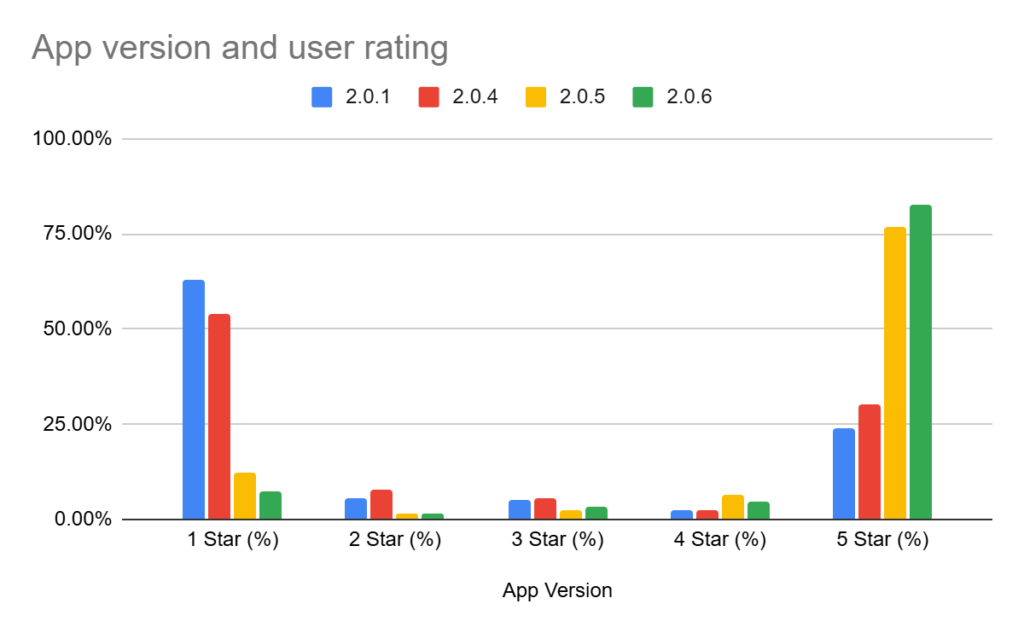
Note: Review score distribution across major versions of Indonesia’s IKD App.
As the data shows, the score distribution underwent a turnaround. In version 2.0.1, a staggering 62.8% of reviews were 1-star, while 5-star reviews languished at 24.1%. By version 2.0.6, 1-star reviews plummeted to just 7.5%, while 5-star reviews surged to 82.8%.
This rare public-sector achievement was driven by an aggressive focus on fixing the low-level technical bugs causing widespread exclusion.
For instance, one of the most debilitating bugs in older versions involved the facial recognition module. On mid-to-low-end smartphones, the exact devices carried by the majority of working-class Indonesians, the camera shutter button would frequently freeze. This prevented users from completing registration without an officer’s high-spec device. A citizen detailed how the version 2.0.5 update resolved this systemic barrier:
“An amazing update… Before this, when doing the photo verification on my phone, the camera shutter button couldn’t be pressed. I saw on the ground that many people wanted to register but were blocked by this bug. Because of that, people were told by officers to use someone else’s phone with higher specs. But now it’s okay, now there is a real change.”
By resolving this single hardware compatibility issue, developers didn’t just fix code; they also democratized access. They removed the need for expensive hardware or administrative intervention, instantly unlocking the app for thousands. Praise shifted from frustration to an appreciation of efficiency, with citizens celebrating the ability to see their family’s documentation in one secure place without carrying physical folders.
Strategic Lessons for Global Policymakers
The narrative arc of Indonesia’s IKD app offers at least four lessons for international donors, development banks, and government leaders investing in DPI worldwide:
- Design for Minimal-Human-Intervention onboarding for greater autonomy. The early failure of IKD was tightly linked to the requirement of visiting a physical office for activation, which replicated the exact bureaucratic hurdles DPI is meant to destroy. The success of later versions proves that when you allow citizens to onboard reliably from home, adoption curves spike and public satisfaction follows.
- Fostering public trust and adoption through local hubs: During technical disruptions or difficult onboarding processes, local civic hubs provide essential, human-centric support—clearing registry errors in real time and relieving pressure on tech infrastructure. This frontline presence creates a feedback loop: local non-profits, academic institutions, and private-sector partners can harvest these field insights to drive permanent administrative reforms.
- UX (User Experience) is an inclusion and trust issue, not an aesthetic one. In the private sector, poor UX means a lost customer. In DPI, poor UX means civic exclusion and institutional mistrust. If a citizen cannot complete verification independently, the infrastructure ceases to be ‘public’ because it excludes those with disability, limited digital literacy, or cheaper devices. Funding must place user-testing and edge-case debugging on equal footing with core architecture.
- DPI requires continuous, agile funding. Traditional infrastructure projects like roads and bridges are funded linearly from design to build to hand over the keys. Digital infrastructure cannot be treated this way. Had the Indonesian government abandoned IKD during the turbulent days of version 2.0.1, it would have been remembered as an expensive failure. DPI requires agile, multi-year operational funding that allows product teams to listen to feedback, iterate rapidly, and deploy fixes in real-time.