
Indonesia is currently undergoing one of the largest digital identity transformations in the developing world. By linking the Identitas Kependudukan Digital (IKD) with central social welfare databases, the state aims to eliminate systemic leakages.
This analytical piece evaluates the narrative surrounding this transition. Drawing on a media content analysis of 285 news articles published in Detik.com, one of the most visited sites in Indonesia, between August 2022 and June 2026, KETEMU maps out policy timelines, structural vulnerabilities, and the critical role of human infrastructure in digital governance.
Chronology of a Transformation
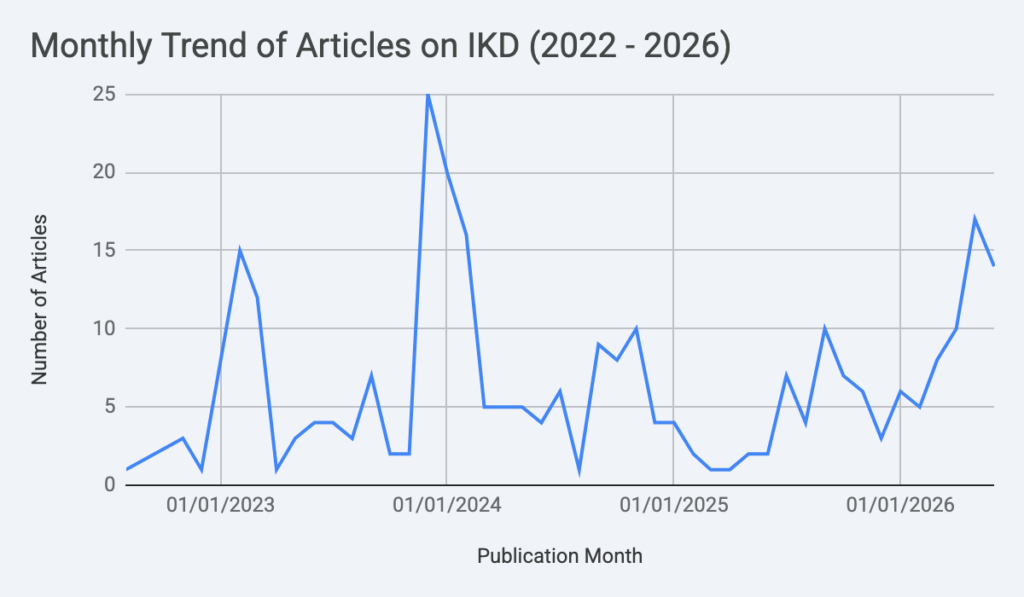
The transition from a physical identity card to a decentralized digital application is rarely linear. It is often driven by bureaucratic deadlines and public anxiety. Our media research traces this policy cycle through coverage intensity.
- The 2023–2024 Peaks: Public discourse and media reporting peaked between December 2023 (25 articles) and January 2024 (20 articles), aligning with the government’s aggressive initial push and announced deadlines.
- The 2026 Resurgence: Coverage surged again in early 2026, reflecting the transition from policy design to real-world integration with public services, notably school enrollment and social assistance validation.
What the Keywords Reveal about Citizen Priorities
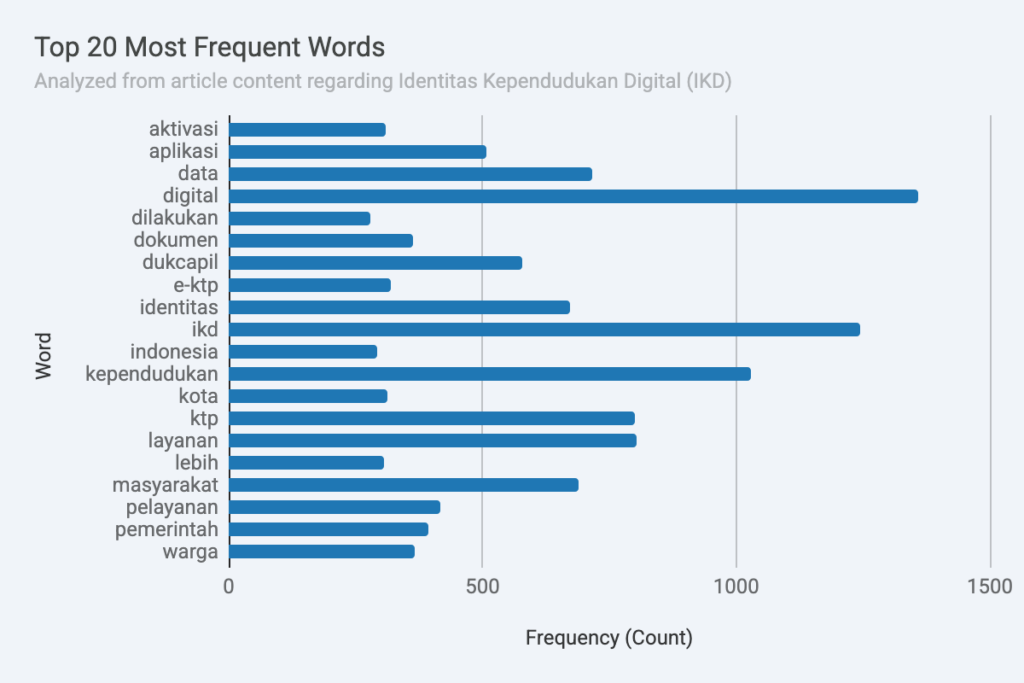
An analysis of these recurring keywords yields at least four critical insights as below.
The overwhelming frequency of terms related to digital identity emphasizes a strong focus on the transition from physical identity cards to digital ones.
- The words “digital” (1,360 occurrences) and “ikd” (1,244 occurrences) are the most frequent, showing that the news is highly focused on the rollout and implementation of the Digital ID application.
- The term “kependudukan”/ “population” (1,030 occurrences) paired with “ktp”/ “ID card” (799 occurrences) and “e-ktp”/ “e-ID card” (320 occurrences) highlights discussions comparing or transitioning from traditional electronic KTPs to the new digital format.
- The word “identitas”/ “identity” appears 671 times, reinforcing the core objective of establishing secure digital identification for citizens.
Additionally, the analysis shows that a significant portion of the conversation revolves around public administration and how citizens interact with these new systems.
- The term “dukcapil”/ “civil registry office” (578 occurrences) stands out as the primary government body responsible for driving this initiative and managing public records.
- Terms like “layanan” (803 occurrences) and “pelayanan” (416 occurrences), which both mean “service” in English, indicate that the articles heavily discuss the quality, availability, and efficiency of public services during this digital shift.
- The frequent mention of “masyarakat” (689 occurrences) and “warga” (365 occurrences), which mean “society” in English, shows a citizen-centric narrative, focusing on public adoption, challenges, or benefits to the community.
The practical aspects of deploying a digital identity system are also prominently featured in the news.
- The words “data” (715 occurrences) and “aplikasi”/ “application” (507 occurrences) point to discussions about data security, system integration, and the performance of the official mobile application.
- The words “aktivasi”/ “activation” (309 occurrences) and “dokumen”/ “document” (363 occurrences) reflect the operational steps citizens must take to activate their digital profiles and integrate their official documents into the app.
Moreover, while IKD is a national mandate directed by the central government, our analysis shows that its execution and media visibility are highly localized and strongly tied to economic sectors.
- While national news sections (226 combined articles across standard and general news portals) drove the overarching policy narrative, regional coverage highlighted stark differences in implementation.
- Localized reporting was dominated by East Java (detikJatim with 21 articles), followed closely by Central Java (15 articles) and Bali (15 articles). These regions served as critical testing grounds for municipal rollouts and “jemput bola” (mobile registration) campaigns.
- The Finance section (detikFinance) contributed 43 articles to the dataset. This high volume reveals that the driving force behind digital identity adoption is closely linked to banking integration, digital financial inclusion, and the formal economy.
Resolving the “Bansos” Distribution Crisis
The most critical application of IKD is its integration into the social safety net. Our content analysis furthermore isolated 22 specific articles dedicated exclusively to the intersection of digital identity and social assistance (bantuan sosial/ bansos). The analysis identifies the following critical risks and corresponding mitigation strategies to safeguard the digitalization of social assistance in Indonesia:
- Media reports highlight the massive scale of inefficiencies in legacy systems, citing an estimated Rp 14–17 trillion in misallocated funds within the Program Keluarga Harapan (PKH) and food assistance programs due to data errors.
- Field audits captured in regional reports exposed severe data vulnerabilities. In Denpasar, data validation revealed that up to 93% of low-income citizens in specific tiers were initially excluded from aid due to identity discrepancies, while ineligible civil servants were mistakenly registered. In Mataram, audits uncovered cases of identity fraud where affluent individuals held double registrations across regency borders to claim poverty benefits.
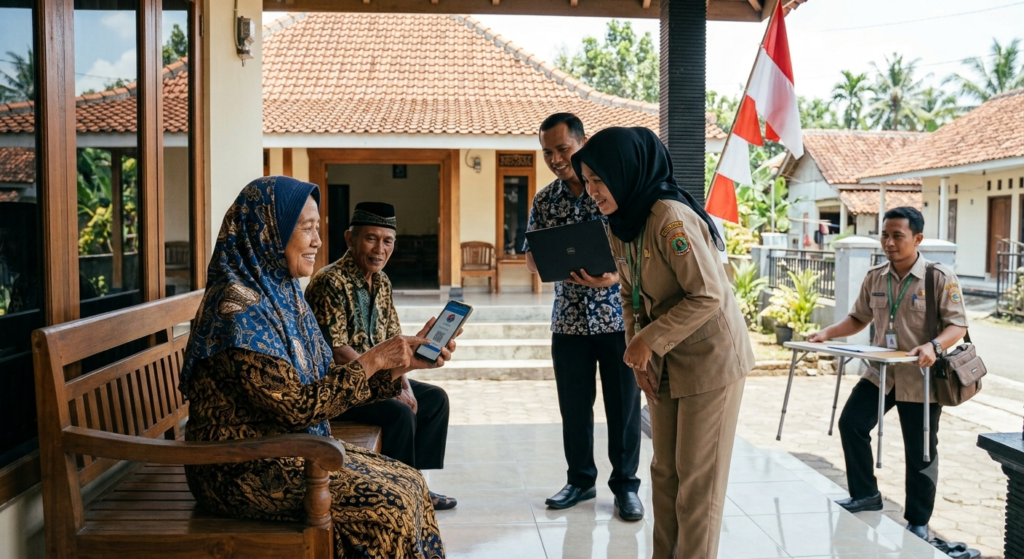
- To mitigate these data risks, the media narrative documents a mobilization of human infrastructure. Rather than relying solely on automated software, local governments deployed armies of field workers, including 13,094 agents in Surabaya and 2,600 in Buleleng, to conduct door-to-door biometric verification using facial recognition tech.
Conclusion
Our media analysis confirms that Indonesia’s technical capability to process data has improved, collapsing verification times from three months to under three minutes via the government’s central data highway (SPLP). However, the real bottleneck remains public adoption and systemic data trust.
For policymakers, the analysis serves as a clear warning that digital public infrastructure cannot succeed in isolation. To bridge the gap between the 20 million current users and the 211 million wajib KTP population, the state must continue: to fund massive frontline human infrastructure, maintain robust hybrid fallbacks for vulnerable groups, and pair digital ID registration with immediate, tangible public service benefits.