

What does progress mean if it leaves millions behind? As Artificial Intelligence (AI) reshapes economies and governance across Southeast Asia, this question is more urgent than ever. Vietnam’s recent Law on Digital Technology Industry signals a bold ambition to place AI and semiconductor technologies at the center of national development. Indonesia is following suit, accelerating its digital transformation and promoting AI as a driver of efficiency and innovation.
Yet optimism alone cannot mask a critical reality: Who benefits from AI, and who risks being excluded?
The Promise and the Peril for Marginalized Communities
AI is often celebrated as a tool for inclusion, promising solutions to accessibility challenges for people with disabilities (PwDs). However, Dr Abdul Rohman, the Co-founder of KETEMU, identified a sobering reality: in Vietnam and Indonesia, AI remains “formidable but foreign” to many PwDs. This is not because of inherent complexity but because of persistent information gaps and systemic neglect.
This disconnect exposes a deeper governance dilemma. Global debates on AI ethics and regulation are dominated by voices from the Global North, leaving developing nations and their most vulnerable populations underrepresented. Developmentalist slogans like “AI for Good” sound inspiring, but without structural change, they risk becoming hollow.
Vietnam’s Aspirations and Its Blind Spots
Vietnam’s policy discourse frequently invokes inclusivity, using terms like “everyone” and “all citizens.” Yet, Dr Rohman argued, equality is often conflated with uniformity. Applying the same standards to all in an unequal system deepens exclusion.
Among 25 technology-related policy documents reviewed, only three mention disability, and even then, primarily as a category for protection rather than empowerment. Inclusive design remains optional, and many local platforms lack basic accessibility features.
The Law on Digital Technology Industry acknowledges risks posed by AI to marginalized groups, but by grouping disability with age and economic hardship, it overlooks the unique challenges each faces. Protection alone is insufficient; empowerment through targeted education, training, and systemic accessibility measures is essential.
Indonesia: A Parallel Struggle
Indonesia mirrors these challenges. Despite its vibrant tech ecosystem, disability inclusion in AI governance is minimal. Dr Rohman’s study highlights that Indonesian PwDs often perceive AI as alien, not because of complexity, but because of an “information void” within disability communities. This gap is compounded by limited policy attention and scarce resources for inclusive design.
What Inclusive AI Governance Must Entail
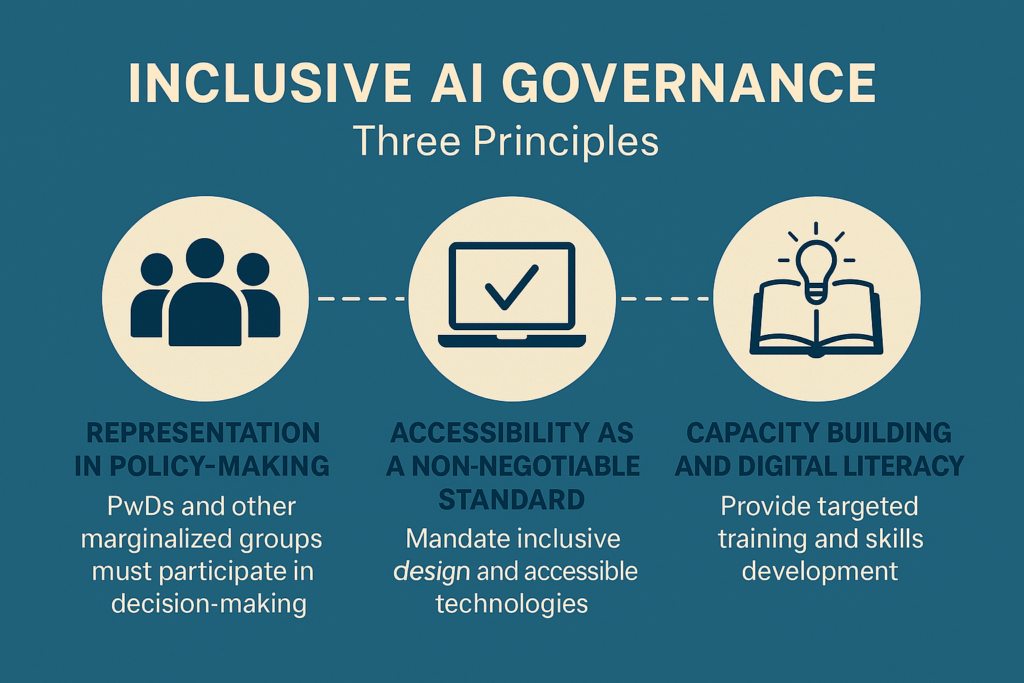
If Vietnam and Indonesia are serious about inclusion, three principles must guide their approach:
- Representation in Policy-Making
PwDs and other marginalized groups must have a seat at the table. Governance frameworks should institutionalize participatory mechanisms, ensuring those most affected by AI are active shapers of technology, not passive recipients. - Accessibility as a Non-Negotiable Standard
Inclusive design should be mandated, not optional. Governments can incentivize compliance through tax benefits or public procurement preferences for accessible technologies. - Capacity Building and Digital Literacy
Bridging the information gap requires targeted programs that equip PwDs with skills to navigate and leverage AI tools. This is not charity; it is a prerequisite for equitable participation in the digital economy.
Inclusive AI Governance: Southeast Asia’s Defining Test
Vietnam and Indonesia stand at a crossroads. Their choices will influence not only national trajectories but also regional norms for AI governance. By embedding inclusion into the DNA of digital policies, these nations can transform AI from a symbol of inequality into a catalyst for social justice.
Conversely, neglecting these imperatives risks creating a two-tiered digital society, one where innovation thrives for the privileged while the marginalized remain in the shadows.
As Southeast Asia positions itself in the global AI race, success should not be measured by technological sophistication alone, but by the extent to which every citizen, regardless of ability, can claim ownership of the digital future.